
Development of peripheral regions:a quali-quantitative study of the southernmost areas in America and Europe
Rodrigo KATAISHI  *
*
Dario MUSOLINO *
Daniele BRUOGNOLO *
Abstract. This study compares the economic development of Tierra del Fuego (Argentina) and Calabria (Italy), two highly peripheral regions. Despite their remoteness, they exhibit contrasting trajectories: Tierra del Fuego shows industrial growth driven by state-led policies, while Calabria faces stagnation despite EU support. Using a mixed-methods approach (quantitative institutional data and semi-structured direct interviews), we analyse factors influencing these divergent paths. Findings highlight the crucial role of institutional frameworks and sectoral specialisation, challenging the assumption that peripherality inherently hinders development. Remoteness does not necessarily preclude development. We suggest policy and strategic positioning can transform peripheral status into a catalyst for development.
Key words: peripheral regions, accessibility, manufacturing, development, location factors, Argentina, Italy.
1. Introduction
The development of peripheral regions has long been the subject of academic debate, often framed within narratives of structural disadvantage at global or local scales (Oppido et al., 2023; Pezzi and Urso, 2016). Geographic isolation, relative location, difficult relationships with major economic hubs, history, and distinct patterns of integration into global markets are typically regarded as fundamental obstacles to growth in these regions (Kühn, 2015; Blowers and Leroy, 1994). While existing literature emphasises the constraints imposed by peripherality, the extent to which geographic remoteness necessarily leads to economic stagnation remains contested (Eder and Trippl, 2019; Frank, 1967). Rather than a fixed condition, peripherality is increasingly understood as a dynamic and relational phenomenon shaped by historical trajectories, institutional frameworks, and economic activity patterns (Oppido et al., 2023; Prebisch, 1949). Structural dependencies, governance asymmetries, and unequal access to resources and decision-making processes contribute to the persistence of regional disparities over time (Cardoso and Faletto, 1969; Kühn, 2015).
This study examines two highly peripheral regions located on the southern extremities of their respective continents, America and Europe: Tierra del Fuego in Argentina, and Calabria in Italy. Both regions are situated at the margins of national and continental peripheries, yet they differ significantly in economic structures, sectoral composition, and policy frameworks (Musolino, 2018; Musolino and Panuccio, 2022; Kataishi et al., 2023; Kataishi and Ortiz, 2024). Their shared characteristic of geographic remoteness makes them valuable case studies for exploring whether peripherality inherently acts as a constraint or if specific conditions enable the emergence of distinct economic models (Eder, 2019; Fitjar and Rodriguez-Pose, 2011; Kataishi and Brixner, 2024).
The research investigates whether geographic isolation inevitably hinders development (Kim, 2013; Letaifa and Rabeau, 2013) or if it can, under certain circumstances, generate competitive advantages (Buheji, 2020) and new development trajectories (Ganesan et al., 2005). Despite its distant location from national and continental cores, Tierra del Fuego has experienced notable economic and demographic growth, driven largely by state-led industrial policies (Deluca and Kataishi, 2023). In contrast, Calabria faces persistent stagnation and population decline, marked by weak institutional support and economic fragmentation (Ferdinando et al., 2023; Musolino and Panuccio, 2022; Musolino, 2018). This divergence problematises the notion that peripherality inherently constrains development, instead foregrounding the pivotal influence of institutions, policies, and local agency in shaping regional trajectories.
The contribution of this study lies in its reassessment of geographic peripherality through the lens of socio-economic and institutional frameworks, highlighting their role in shaping developmental trajectories in regions traditionally viewed as disadvantaged. By examining Tierra del Fuego and Calabria – two geographically remote regions with diverging economic paths – it challenges the assumption that remoteness inherently leads to stagnation. Through this comparative analysis, the research reframes peripherality as a dynamic and contingent condition rather than a deterministic constraint. It underscores the significance of governance, sectoral specialisation, and institutional agency in fostering regional resilience, ultimately demonstrating that tailored policies and institutional coordination can transform peripheral status into a catalyst for development.
The paper addresses three core research questions: (1) Does extreme peripherality necessarily hinder economic development, or can it enable alternative growth models? (2) What factors – structural, institutional, or policy-related – account for the differing outcomes in Tierra del Fuego and Calabria? (3) Can peripherality itself become an advantage under specific circumstances? To answer these, we aim to analyse and compare the development models of these regions, identifying the drivers behind their contrasting performances.
Our approach combines quantitative and qualitative methods. We draw on statistical data from Argentine (INDEC, IPIEC) and Italian (ISTAT) sources, including metrics such as population trends, GDP per capita, and employment rates. Complementing this, we conducted semi-structured interviews with 15 key informants (10 from Calabria, 5 from Tierra del Fuego) between June 2019 and February 2020, analysing the responses through semantic and thematic techniques. This dual methodology provides a comprehensive view, blending empirical trends with stakeholder perspectives.[1]
The paper is structured as follows: Section 2 details the case study regions and their selection rationale. Section 3 presents a comparative analysis of their demographic and economic profiles. Section 4 explores findings from the interviews data, focusing on local development dynamics. Section 5 synthesises results and discusses broader implications. Through this systematic examination, we seek to clarify how peripheral regions navigate their geographic constraints, offering evidence that challenges conventional assumptions about remoteness and development.
2. Theoretical framework
Peripherality has long been framed as a condition of structural disadvantage, traditionally understood as a geographic and economic reality that limits a region’s development prospects (Amin, 1976; Prebisch, 1972; Kühn, 2015). However, contemporary scholarship increasingly conceptualises peripherality as a dynamic and relational phenomenon shaped by historical, institutional, and economic processes (Blowers and Leroy, 1994; Fischer-Tahir and Naumann, 2013; Rodríguez-Pose, 2018). Rather than being a fixed characteristic of remote territories, peripherality is produced and reinforced through patterns of capital accumulation, governance asymmetries, and integration into global economic networks (Arrighi, 1994; Gereffi, 1999).
Peripherality is not merely a matter of geography or distance from urban centres; it is increasingly understood as a multidimensional condition shaped by socio-economic and institutional relations that reveal configurations of power dynamics, inequalities, and development trajectories over time. In this view, being “peripheral” is a socially constructed status emerging through interactions between core and peripheral regions. Classic theories (Prebisch, 1949, 1972; Furtado, 1964; Dos Santos, 1970; Cardoso and Faletto, 1969) rooted in the Latin American structuralist tradition established the core-periphery framework in economics, which later informed dependency theory. These scholars emphasised that peripherality is produced and reinforced by historical patterns of hierarchical relations: core-periphery models, for instance, illustrate a dynamic where central regions concentrate decision-making power, resources, and innovation, while peripheral regions are confined to subordinate roles (Amin, 1976). Such dynamics are historically shaped as communities grow, expand, or conquer one another (Frank, 1967). Crucially, this concept is not an inherent or immutable characteristic of a place. Instead, it arises from complex interactions in which certain locations become “central” by accumulating wealth, talent, and influence, whereas others are relegated to “peripheral” status due to subordination to the core and internal disparities. This highlights divergent development trajectories between regions and underscores that peripheral status must be defined relationally – it is not a fixed state but may shift over time due to changes in underlying relationships (e.g., political power, economic networks, global hierarchies, or production systems). Peripherality should thus be regarded as a socio-spatial construct, produced through structural relations, policy frameworks, and narratives developed over time, rather than a natural outcome of geographic location alone (Lang and Görmar, 2019; Copus, 2024).
Economic inequality and disadvantage lie at the heart of the core-periphery relationship. From an aspatial (Copus, 2024) structural perspective, peripheral regions tend to be economically specialised in natural resource exploitation, extraction of raw materials, assembly, or other labour-intensive activities. Classic works (Prebisch, 1949; 1972; Furtado, 1964; Gereffi, 1999) noted that this peripheral specialisation leads to uneven trade relationships, tending to export non-complex goods or cheap labour (Ziesemer, 1994) and import higher-value products from the core (Toye and Toye, 2003; Prebisch, 1952), creating a drain of surplus and a reliance on external technologies, capital and markets (Rae, 2017). This means the periphery’s accumulation processes are largely determined by their interactions with other regions, and especially with the core (e.g., influencing commodity price setting, investment flows, corporate strategies, government decisions, political lobbying, and governance), rather than by local actors. Core accumulation and wealth, in this sense, is often associated with lower levels than the core and with a systematic and historically constructed submission to other regions (Baer, 1962).
According to this view, poorer regions are not merely “left behind” by historical accidents or a failure to catch up with developmental trajectories (Rostow, 1985). Instead, they are often rendered poor and unequal through socio-economic relations rooted in their integration into modern capitalism. This process stems from factors such as how, when, and why these regions were incorporated into global capitalist systems, their internal socio-economic and institutional configurations (both pre and post-integration), their enduring trade and exchange linkages with other regions, and the resulting accumulation processes, which are weaker than those in core areas (Frank, 1979; Roberts, 2013; Wilmsmeier and Monios, 2013). Over time, these dynamics manifest as chronic underinvestment, limited industrial diversification, low economic complexity, and – in many cases – brain drain, as skilled workers migrate to core regions for better opportunities (Docquier and Rapoport, 2012; Ameel et al., 2015). The concept of uneven development encapsulates this phenomenon, wherein capital and growth concentrate in “central” regions, while peripheral areas face systemic resource constraints, internal inequalities and specialisation lock-in (Meeker, 1984).
The emergence of new economic geography has contributed further insights into the dynamics of core-periphery divisions (Krugman, 1991; Capello and Cerisola, 2020). The concentration of economic activity in central areas is reinforced by economies of scale, knowledge spillovers, and factor mobility, creating a self-reinforcing cycle of agglomeration (Fitjar and Rodríguez-Pose, 2011). Peripheral regions, by contrast, suffer from higher production and transaction costs, lower innovation diffusion, and weaker labour markets (Baumgartner et al., 2013; Eder and Trippl, 2019). However, peripherality is not solely a function of physical distance; it is also determined by the degree to which a region is embedded within global value chains, entrepreneurial networks, and knowledge-intensive sectors (Bentivogli et al., 2018; Baumgartner et al., 2013). Relational remoteness (Kühn, 2015), rather than simple geographic isolation, plays a crucial role in defining the constraints and opportunities available to peripheral economies (Rodríguez-Pose, 2018; Stöhr, 1978).
Yet, it is important to note that these patterns are not permanent. They can be mitigated through deliberate interventions (Stöhr, 1978; Wilmsmeier and Monios, 2013; Rae, 2017) – such as industrial policies, investments in local capacity, or integration into new markets – that aim to transform the unequal relations shaping a region’s role (Blomgren and Sørensen, 1998). Contemporary discussions about “places that don’t matter” (Rodríguez-Pose, 2018) highlight how prolonged neglect of marginalized regions can exacerbate social discontent, underscoring the need for proactive investments to rebalance development (Crone, 2012; Grabher, 2018) by fostering integration into larger economic systems (Eder, 2019; Oppido et al., 2023). Nevertheless, the execution of such investments hinges on socioeconomic stability, technological capabilities, macroeconomic conditions, and institutional frameworks, which often perpetuate cycles of decline and reinforce peripheral status over time (Hojman and Szeidl, 2008; Street, 1987; Servillo et al., 2016).
Within the centre-periphery framework, the nature of relations plays a critical role, as political affinity, regional dynamics, and strategic interests significantly shape interactions (Copus, 2009). For example, focusing on the first two factors, regions with closer ties to core areas often face fewer cycles of economic decline – simplified here as social instabilities arising from inequalities that indirectly destabilise the core. Crucially, closeness in this context transcends geographic proximity (Copus, 2024). Instead, it reflects a region’s integration into networks of capital, knowledge, political influence, cultural exchange, and institutional access that underpin core economies. Excluded regions that strengthen these linkages – through strategic economic positioning, policy alignment, or institutional cooperation – may experience less severe economic downturns and greater capacity to reposition themselves within global hierarchies (Stöhr, 1978). This phenomenon may raise important implications on the comparison of two peripheral regions that belong to different continents. Strategies such as the creation of special economic zones, targeted industrial promotion, and investments in connectivity can alter regional dynamics by fostering integration into larger economic systems and, in some cases, extreme peripheral locations can even be transformed into competitive advantages, particularly when linked to strategic assets such as natural resources, tourism, or geopolitical positioning.
However, the result of interventions may not be uniform across different contexts, as their effectiveness is mediated by preexisting frameworks, governance structures, and historical trajectories. Policies that successfully promote economic integration and development in one peripheral region may yield limited or even adverse effects in another, depending on factors such as local capacities, path dependent patterns, and the broader geopolitical environment (Kühn, 2015; Rodríguez-Pose, 2018). Thus, while targeted interventions can facilitate upward mobility within global or regional hierarchies, their outcomes remain contingent on a complex interplay of endogenous and exogenous forces, making direct policy transfers between regions highly uncertain (Blowers and Leroy, 1994; Fischer-Tahir and Naumann, 2013; Kataishi and Morero, 2020).
The persistence of peripherality is shaped not only by economic structures but also by political and institutional asymmetries (Jessop, 2016). Marginalised regions often face constraints stemming from decision-making processes dominated by central actors, reinforcing their reliance on external resources and influence (Ameel et al., 2015). This constitutes a multi-scalar dynamic in which global, national, and local forces intersect, conditioning the capacity of peripheral areas to autonomously alter their structural position (Sibley, 1986; Prebisch, 1972). While integration into multi-level decision-making networks can provide pathways for relative mobility (Servillo et al., 2016), the degree to which regions leverage these connections depends on their ability to negotiate favourable terms within internal and external power structures (Meeker, 1984). Consequently, peripheral regions often depend on policies and administrative frameworks misaligned with local needs (Rivera León and Kataishi, 2010), creating a disconnect between formal governance, institutional agency, and situated strategic goals (Fischer-Tahir and Naumann, 2013).
Additionally, social and cultural dimensions represent a critical dimension to emphasise in peripheral constructs. Structural heterogeneity, as theorised by Prebisch (1949), reflects the coexistence of inequalities not only in economic and institutional systems but also in societal development trajectories. Peripheral regions are often poorer and more unequal than core areas, experiencing demographic decline as result (Barlösius, 2023). Deficiencies in infrastructure, healthcare, and education exacerbate these challenges (Paasi, 1995), perpetuating cycles of disadvantage. Beyond material conditions, symbolic hierarchies and discursive constructs also play a role. Fischer-Tahir and Naumann (2013) observe that peripheral regions are frequently framed as “backward” or “remote” within national and global imaginaries, shaping local idiosyncrasies and self-perceptions (Opie, 2010). These narratives influence investment decisions (Musolino et al., 2020), policy priorities, and the aspirations of residents, reinforcing patterns of inequality (McDonald et al., 2018). However, some scholars argue that adversity fosters resilience, with peripheral communities cultivating robust mutual support networks and distinct cultural identities (Amin, 1976). In this sense, structural heterogeneity transcends economics, reflecting a broader process that shapes how regions are perceived, interconnected, and valued within larger systems (Blowers and Leroy, 1994; Fornes and Mendez, 2018).
3. Contextualization
3.1. Why Tierra del Fuego and Calabria? The case study regions
Tierra del Fuego and Calabria share a condition of geographic peripherality within their respective national and continental contexts. However, their economic and demographic trajectories diverge significantly due to differences in institutional frameworks, policy interventions, and sectoral specialisation. Over the past decades, Tierra del Fuego has experienced rapid population growth and economic expansion, largely driven by its strategic positioning in national industrial policy. In contrast, Calabria has faced persistent demographic decline and economic stagnation despite continuous public interventions. Understanding the factors shaping these divergent paths requires a closer look at their historical and economic evolution before delving into their structural characteristics and development models.
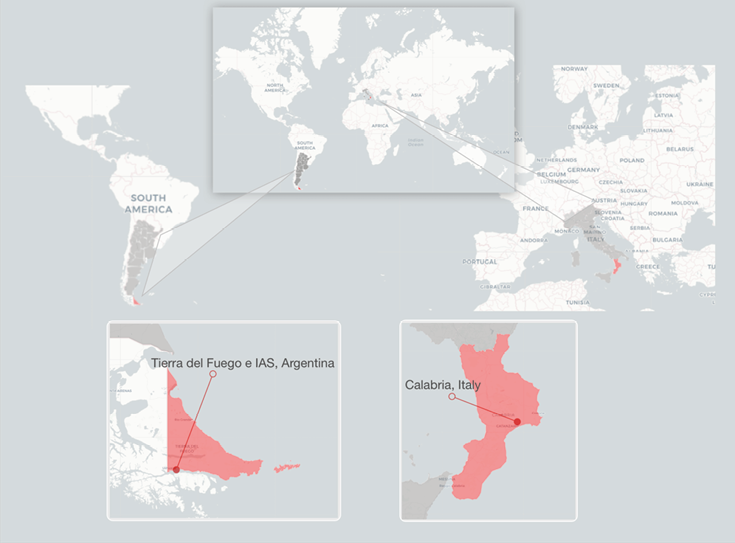
The choice of study areas – Tierra del Fuego in Argentina and Calabria in Italy – is driven by several factors. Both are highly peripheral regions. Firstly, in relation to their respective countries: Calabria is the southernmost ‘tip of the boot,’ while Tierra del Fuego is located at the extreme south of Argentina. Secondly, in relation to their respective continents, Europe and South America. Both regions are thus characterised by low levels of accessibility compared to the central areas of their respective countries and continents.
Tierra del Fuego remained largely uninhabited until the late 19th century, when Argentina began consolidating its national territory through military expeditions and settlement policies. Its early economy was based on fishing, livestock, and oil extraction, but its extreme remoteness limited significant development. A turning point came with the introduction of Law 19.640 in 1972, which created a special economic and fiscal regime to promote industrialisation through tax and customs incentives. This transformed Tierra del Fuego into Argentina’s most industrialised province, attracting large-scale internal migration and fostering a manufacturing sector focused on electronics, household appliances, and hydrocarbons. However, this growth model remains highly dependent on national policies and external inputs, rather than on the development of local production networks or export-oriented industries.
Calabria, by contrast, has a much longer history of human settlement, with economic structures dating back to ancient Mediterranean trade routes. Historically an agrarian region, its economic base remained centred on small-scale farming and rural economies well into the 20th century. Unlike Tierra del Fuego, Calabria was deeply affected by waves of outmigration, particularly during the industrialisation of northern Italy, which further weakened its labour force and economic prospects. Despite continuous public interventions – including national subsidies and European Union structural funds aimed at fostering convergence – Calabria remains one of the poorest regions in Italy, struggling with high unemployment, low industrial diversification, and a fragmented business landscape. Unlike Tierra del Fuego, which was transformed through targeted industrial policy, Calabria’s reliance on infrastructure investments and financial aid has not resulted in sustained economic transformation.
Although both regions are considered peripheral within their national and continental contexts, their positions shift when viewed on a broader scale. Calabria, often seen as distant from Italy’s economic core, occupies a strategic position within the Mediterranean, historically serving as a crossroads of trade and migration. Similarly, Tierra del Fuego, while the southernmost province of Argentina, gains prominence when considered in relation to Antarctica, positioning itself as a logistical hub between Buenos Aires and the southern polar region.
Beyond their geographical location, Tierra del Fuego and Calabria share notable physical features. Both are mountainous, a characteristic that offers potential for tourism but also presents infrastructural and economic challenges. Their extensive coastal access further shapes their development: Tierra del Fuego, as an archipelago, is deeply linked to maritime industries, while Calabria, despite being surrounded by sea on three sides, has struggled to fully integrate its coastal economy into broader trade and tourism networks.
However, the two regions differ significantly in climate. Tierra del Fuego transitions from cold temperate steppes in the north to oceanic climates in the south, marked by strong winds and harsh conditions. Calabria, in contrast, enjoys a Mediterranean climate, with mild winters and hot summers, where temperatures along the coast range between 10°C and 40°C, occasionally exceeding 44°C during extreme heat waves.
Source: own work.
Additionally, over the years, as mentioned before, both regions have been the focus of significant policy interventions at the central government and supranational levels (e.g., the European Union), which have profoundly shaped their development trajectories. On the one hand, Tierra del Fuego’s economic growth has been policy-driven, with state intervention playing a decisive role in its industrialisation. Calabria, on the other, has been the recipient of EU cohesion policies, yet these interventions have failed to generate long-term economic dynamism. The comparison of these two cases allows us to explore how different policy models, one based on direct industrial promotion and the other on regional assistance and infrastructure investment, impact peripheral regions in radically different ways.
3.2. Demographic and socioeconomic characteristics: Two diverging models
The two regions have rather different socio-demographic and economic characteristics. Based on quantitative data from institutional sources, their demographic and socio-economic profiles differ significantly.
3.2.1. Population and demographic trend
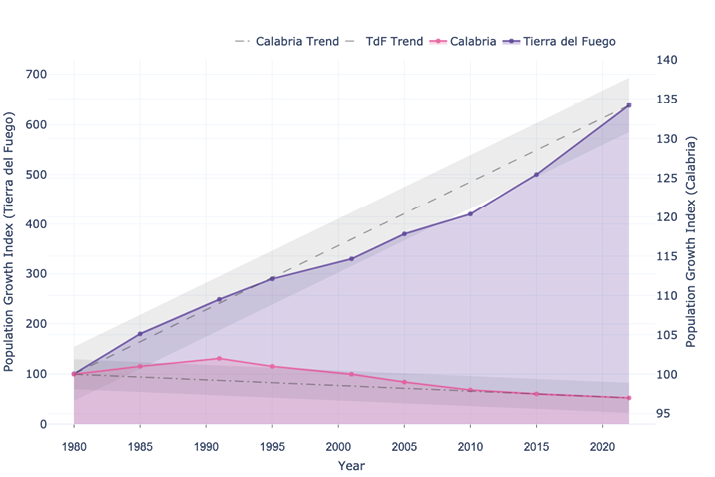
First, the two regions diverge in terms of population. Tierra del Fuego has a much smaller population compared to Calabria. In 2022, the population of Tierra del Fuego was approximately 186,000 inhabitants, while Calabria had 1,855,000 in the same year. However, Tierra del Fuego experienced a rapid demographic growth (Fig. 2), increasing its population sixfold over the last forty years (whereas Argentina’s population grew by only 64% in the same period). This did not happen in Calabria, which has lost about 230,000 people (approximately 11% of its population) since the late 1980s. Its demographic decline is more pronounced than that recorded for Italy as a whole.
Source: own work based on data from INDEC and ISTAT.
On the one hand, the expansive demographic trend in Tierra del Fuego was mainly due to positive net migration, linked to the industrial expansion which attracted there a considerable number of people. The declining trend in Calabria, on the other, has been the result of both negative net migration and negative natural change, evidently linked to stagnation or even a relative decline in the level of development.
3.2.2. Economic performance
The analysis of economic performance in the two regions was conducted based on official sources such as the Italian National Institute of Statistics (ISTAT), the Argentine National Institute of Statistics and Censuses (INDEC), and the Provincial Institute of Analysis, Research, Statistics, and Censuses of Tierra del Fuego (IPIEC).
A crucial indicator for comparing development levels in the two regions is GDP per capita (Table 1). To this end, monetary values from Argentina and Tierra del Fuego were converted into Euros at current prices. It emerges that Tierra del Fuego, with its €23,597.98, is the Argentine province with the highest GDP per capita. Calabria has a GDP per capita of €17,087.30, one of the lowest in Italy. Comparing the GDP per capita for the two regions in current Euros is evidently not a completely accurate exercise; one should consider the GDP per capita in Purchasing Power Parity (PPP) for both regions – that is, its real value. Thanks to World Bank data[2], we were able to estimate it (see Table 1). We found that the “nominal gap” between the GDP per capita of the two regions is significantly larger, almost tripling, when expressed in real terms.
| Indicators | Calabria | Italy | Tierra del Fuego | Argentina |
|---|---|---|---|---|
| GDP (million euros) | 33,435 | 1,724,955 | 3,793 | 442,598 |
| % GDP out of country GDP | 1.94% | 0.86% | ||
| GDP per capita (euros) | 17,087 | 28,519 | 23,598 | 10,043 |
| GDP per capita (euros; PPP) | 21,923 | 38,087 | ||
| Businesses | 108,336 | 4,390,911 | 6,082 | 853,886 |
| Entrepreneurial density (businesses / population) | 5.5% | 7.3% | 3.8% | 2.0% |
| Employees | 537,000 | 23,023,000 | 67,000 | 12,079,070 |
| Employment rate (population over 15) | 31.8% | 44.2% | 54.0% | 36.2% |
Source: own work based on data from ISTAT, INDEC, IPIEC and World Bank.
Another relevant indicator concerns the development of the entrepreneurial system (Table 1). Calabria shows a picture of greater entrepreneurial vitality (5.5%) than Tierra del Fuego (3.8%), although the latter shows a higher propensity for entrepreneurship than Argentina. This is a figure that could certainly be interpreted positively for Calabria, but not necessarily, considering that it could mean a lower presence of medium and large size enterprises.
Relevant differences between the two regions also emerge in relation to employment. Tierra del Fuego clearly outrivals Calabria both in a direct comparison (the employment rate is 54% in Tierra del Fuego versus 32% in Calabria) and in an indirect comparison, where the employment rate in Tierra del Fuego is about 18 percentage points higher than the Argentine rate, while the Calabrian rate is significantly lower than the Italian rate.
3.2.3. Internationalisation
Another key economic dimension is the level of internationalisation, i.e., the export performance and the attraction of Foreign Direct Investments (FDI).
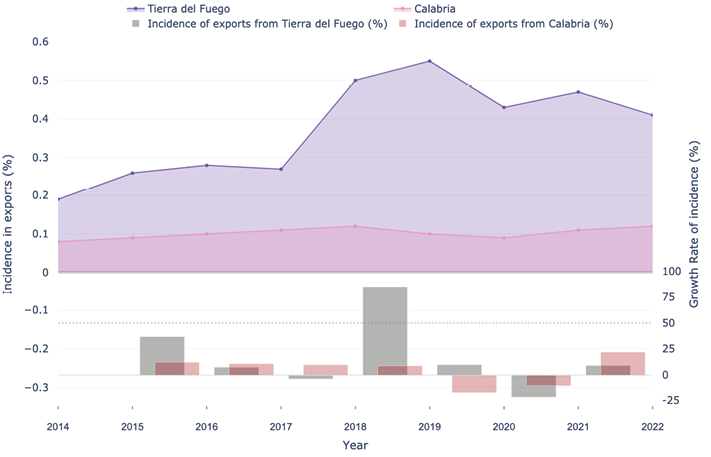
Data on exports highlight a clear difference between Tierra del Fuego and Calabria. The latter is less competitive in international markets. Although increased from 325 million to 879 million euros over the last decade, Calabria’s exports in 2023 accounted for just over 0.1% of the total national exports (Fig. 3). Tierra del Fuego similarly shows a growing trend in exports; however, unlike Calabria, the weight of its exports on the national total is higher (0.55%) and increasing, indicating a superior performance over time compared to its country. In 2023, Tierra del Fuego exported goods worth USD 366 million.
Notably, in 2017, the degree of openness (sum of exports and imports as a percentage of GDP) of Tierra del Fuego was 9%, a figure significantly higher than that of Calabria (3%).
Calabria is a region largely disconnected from global value chains (see also Bentivogli et al., 2018). On the contrary, Tierra del Fuego appears much more integrated into global value chains, although its linkage is predominantly of the ‘forward’ type. This is because its exports are exclusively derived from the exploitation of local natural resources, primarily hydrocarbons and fishery. In contrast, the electronics sector, which is a key part of Tierra del Fuego’s industrial activity, does not participate in exports and is entirely directed towards the domestic market.
As far as the attraction of FDI is concerned, the low level of internationalisation particularly of Calabria emerges as well, confirming the findings of previous studies (Musolino, 2016; Musolino et al., 2020). According to the latest data from ICE-ISTAT[3], just 0.1% of the total national FDI stock is destined to Calabria. Employees in foreign-owned enterprises in Calabria amounted to just over 1,600 in 2017, representing about 0.3% of the total regional workforce, and were mainly concentrated in the transportation and logistics sector (followed by utilities). As far as Tierra del Fuego is concerned (ECLAC, 2024), data from CEPAL shows that 4% of all FDIs registered in Argentina is concentrated in Tierra del Fuego. Over 80% of employees in foreign-controlled enterprises in Tierra del Fuego belong to the extractive or oil sector, while less than 10% refer to the mechanical sector.
Source: own work based on data from ISTAT and INDEC.
3.2.4. Sectoral composition
The analysis of the sectoral composition also shows two rather different models. The analysis which follows here is based on data about employment and added value at the sectoral level.
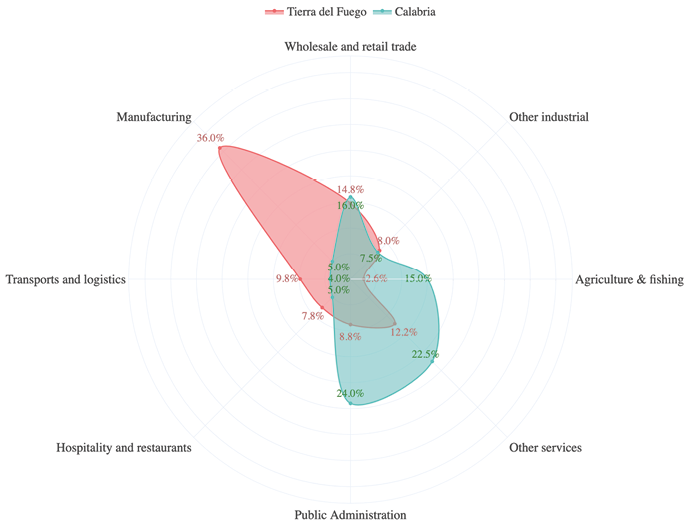
As far as the employment data are concerned (Fig. 4), Tierra del Fuego stands as a highly industrialised region compared to Calabria, and even in the Argentine context. In Tierra del Fuego, in fact, manufacturing accounts for 36% of the total regional employment (20.2% in Argentina) while in Calabria accounts for 5% (less than one third of the Italian average, which is 16%). In Calabria, the primary sector and the services sector, particularly the public sector, still play a crucial role. 15% of the employees in Calabria works in the agricultural sector; a percentage much higher than Tierra del Fuego (2.6%) and Italy in the whole (4%). The Calabrian public sector (including sectors predominantly public, like health and education) account for 24% of the total, whereas in Tierra del Fuego is less than 8%. As far as tourism is concerned (hospitality and restaurants), Tierra del Fuego sounds more developed. While the incidence in Calabria is 5% (less than Italian average, 6%) in Tierra del Fuego is 7.8%, higher than the Argentine average (3.3%).
Source: own work based on data from INDEC and ISTAT.
The data about added value confirms the relevance of manufacturing in Tierra del Fuego compared to Calabria.[4] The manufacturing share of added value in Tierra del Fuego is 17.5%, while in Calabria is 3.8%. Interestingly, the extractive industry also accounts for a high share of the added value in Tierra del Fuego (26.8%), being evidently a highly capital-intensive sector.[5] In Calabria, instead, agriculture accounts for a low percentage of the value added, meaning that it is a sector where the productivity is low.[6] As a result, in Calabria the share of value added of tourism activities and other services sector is high.
3.2.5. The development of manufacturing in Tierra del Fuego
Given these specialisations, what is most interesting and surprising is the relevant development of manufacturing in Tierra del Fuego. Therefore, it deserves to be analysed in greater depth.
The Fuegian manufacturing sector is primarily based on electronic and electromechanical production, which has benefited from the impetus provided by public policies, specifically Law 19.640 of 1972. This law, by providing tax and customs incentives, led to the establishment of exogenous industrial activities.[7]
The main products on which electronics and electromechanical companies in Tierra del Fuego have specialised since the 1980s are televisions, domestic air conditioning systems, and microwave ovens. Audio systems for home use, small appliances, washing machines, and some car parts, such as stereos, control units, and car air conditioning systems, however have also played an important role. Since 1986, the production of televisions has increased following the World Cup. In a later stage, the production of mobile phones and notebooks was also started.[8] Production is mainly concentrated in the city of Rio Grande, which has an industrial park of 122 hectares, and to a lesser extent in the city of Ushuaia.
The electronics and electromechanical sector consist of about 30 companies, highly dependent on the importation of external inputs, a circumstance this has not favoured the development of a local productive fabric of small and medium-sized enterprises. The largest companies in the sector are the Newsan group, the Mirgor group, and BGH. These three are multiproduct companies, as they combine the production of consumer electronics and household appliances (such as microwaves, air conditioners, and other home appliances). Newsan is a multisector conglomerate that expanded even into fishing, food processing industry, and financial services, while Mirgor focuses on the production of electronic goods. Following the acquisition of another local company (FAMAR) in 2019, it has become the only one in the province specialised in supplying electronic inputs (control computers, displays and screens, and dashboard elements) for the automotive industry. BGH, meanwhile, has a profile more oriented toward household appliances compared to the other two, and associates this production with that of mobile phones and other electronic products.
In these productions, Tierra del Fuego plays the role of a passive receiver of technologies developed somewhere else, limiting itself to the performance of final manufacturing activities. Fuegian companies, therefore, do not intervene in the design and research and development processes of the products. This applies to all electronic goods, except for the vehicle sector where there is a role of co-production/co-design. One of the major problems encountered is that consumer final products manufactured in Tierra del Fuego have as their market only the national territory, while intermediate goods can be sold abroad or placed in other na-tional markets, having then export as their final destination.
Thus, despite their shared peripherality, it is quite clear that Tierra del Fuego and Calabria have followed markedly different development trajectories. While Tierra del Fuego has seen industrial expansion driven by national incentives and sustained population growth, Calabria has struggled with demographic decline and persistent economic stagnation despite decades of public interventions. These differences reflect not only structural constraints but also the varying effectiveness of policy approaches in shaping regional development.
To move beyond macro-level indicators and historical trends, a qualitative field survey was conducted to capture the perspectives of key local actors – policymakers, entrepreneurs, and public officials – on the opportunities and challenges faced by each region. The following section presents insights from 15 semi-structured interviews, focusing on regional development models, policy outcomes, and sectoral competitiveness, offering a comparative perspective on Tierra del Fuego and Calabria.
4. Field survey with key informants
To delve deeply into the interpretation of development models of the two regions, a qualitative survey was conducted, featuring 15 semi-structured direct interviews with key informants (Corbetta, 2015), 10 for Calabria and 5 for Tierra del Fuego.[9]
To ensure a sufficient variety of perspectives and expertise, we identified and selected key informants with diverse backgrounds and positions. Among the interviewees were officials or executives of public entities or institutions, provincial legislators, representatives of trade associations, economists, and entrepreneurs. Additionally, several interviewees had technical profiles and played key roles in local initiatives related to development, production, entrepreneurship, public policy, and legislation.
Almost all interviews, conducted between June 2019 and February 2020, were carried out via Skype and lasted about an hour. With the interviewees’ consent, they were recorded and transcribed to best process the information.
Since these were semi-structured interviews, an outline was followed in both Italian and Spanish. The questions focused on five key topics identified as central to this survey: socioeconomic characteristics and development model; development policies; competitiveness and attractiveness (competitive and locational advantages); infrastructure and services; tourism development. We analysed the transcripts of the interviews by means of two techniques: a quantitative semantic analysis, specifically frequency based descriptive analysis, and a thematic analysis.
4.1. The crucial words and topics addressed by key informants: A quantitative semantic approach
Frequency-based descriptive analysis is a fundamental technique in the quantitative semantic approach. It involves examining the occurrence and distribution of individual words within a text corpus (Luhn, 1958) based on the assumption that the frequency of a word reflects its importance and centrality to the themes discussed in the text (Zipf, 1949). By identifying the most frequently used words and phrases in interview transcripts, researchers can detect salient themes, shared experiences, and common perspectives among participants.
This approach enables a systematic and data-driven exploration of large volumes of qualitative data, complementing traditional manual coding methods (Namey et al., 2008). The analysis is two-fold. The first part involves a bigram analysis, while the second focuses on correspondences related to correlation matrices derived from the textual corpus and interviews. The bigram analysis examines the co-occurrence of word pairs, uncovering common phrases and associations within the text (Biber et al., 1998; Manning and Schütze, 1999; Evert, 2005). This method provides a balanced unit of analysis, capturing both specific root meanings and broader semantic senses of the text, offering more coherent and interpretable topics by considering the co-occurrence of related words (Blei and Lafferty, 2009).
Complementing the bigram analysis, correlation matrices explore the relationships and similarities between interviews and the co-occurrence of topics across the text corpus. These matrices visualise and quantify associations within the data, allowing the identification of patterns and connections that illustrate underlying correspondences across groups in the fieldwork (Friendly, 2002). By constructing correlation matrices, where each cell represents the correlation coefficient between two interviews, we aim to uncover patterns and connections that reveal shared narratives and common experiences, both within and between locations (Tierra del Fuego and Calabria). Additionally, examining the correlation matrix of topics across interviews provides a detailed view of underlying differences, highlighting idiosyncratic patterns in bigram relevance. The correlation coefficient measures the similarity or dissimilarity of the content discussed in each pair of interviews (Ahlgren et al., 2003; Namey et al., 2008). By visualising the interview correlation matrix using techniques such as heatmaps or clustered matrices, we can identify clusters or groups of interviews that exhibit strong similarities, potentially revealing shared narratives or common experiences among participants (Perer and Shneiderman, 2008).
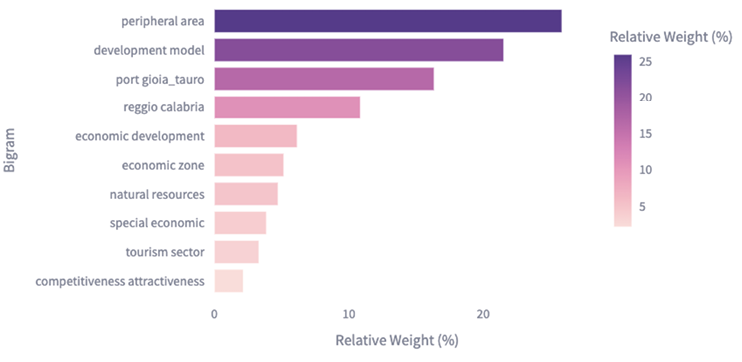
The analysis of the general bigrams reveals several key topics central to discussions across the entire dataset (Fig. 5). Among the most prominent are ‘Peripheral Area,’ ‘Development Model,’ and ‘Port Gioia Tauro.’ These terms reflect a multidimensional approach to regional development, incorporating economic, policy, and resource management perspectives. The emphasis on ‘Peripheral Area’ underscores concerns about geographic marginalisation, while ‘Development Model’ points to ongoing debates on effective frameworks for fostering growth.
Source: own work based on the interviews’ texts.
Figure 5 presents the aggregated frequency of all fieldwork data, offering insights distinct from the region-specific analyses. Although there is a bias due to the greater number of interviews conducted in Calabria, the results still reveal notable variations between the two cases. This aggregated view contributes to a broader understanding of the overall perspective, which differs from the perspectives emerging from each region’s interviews individually. The most significant terms, such as ‘Peripheral Area’ and ‘Development Model,’ carry substantial semantic weight. The prominence of ‘Development Model’ across narratives suggests a critical examination of alternative economic and social frameworks aimed at fostering regional growth. In this context, the discussion of ‘Peripheral Area’ reflects concerns about marginalisation and the need for inclusive strategies tailored to regions on the periphery of economic development.
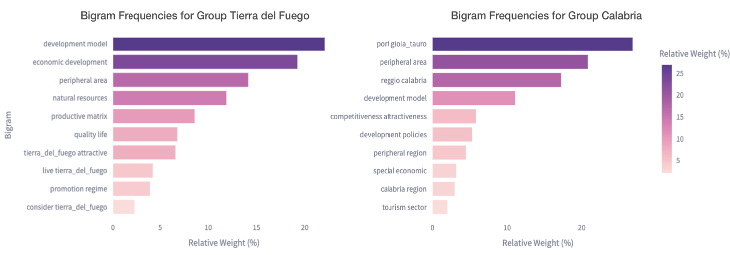
Comparing Calabria and Tierra del Fuego (Fig. 6), several common themes emerge in their bigrams. Both regions emphasise the relevance of “Development Model”, highlighting mutual interests in improving economic conditions and exploring various frameworks for growth in their narratives. The shared concern with ‘Peripheral Area’ underscores the common challenges of addressing marginalised regions. Although there are differences among interviews and groups of interviews, these two topics emerge as the most important topic pairs of the entire fieldwork and within each group.
Despite these commonalities, there are notable differences between the two regions. Calabria’s focus on ‘Port Gioia Tauro’ and ‘Reggio Calabria’ reflects the strategic importance of these locations in its regional development. In contrast, Tierra del Fuego places a stronger emphasis on ‘Sustainable Development’ and ‘Quality Life,’ indicating a greater focus on sustainability and cultural aspects. Additionally, ‘Natural Resources’ has a higher relative weight in Tierra del Fuego, suggesting a more significant focus on resource management. These differences highlight the unique regional characteristics and priorities in development strategies for each area.
Source: own work based on the interviews’ texts.
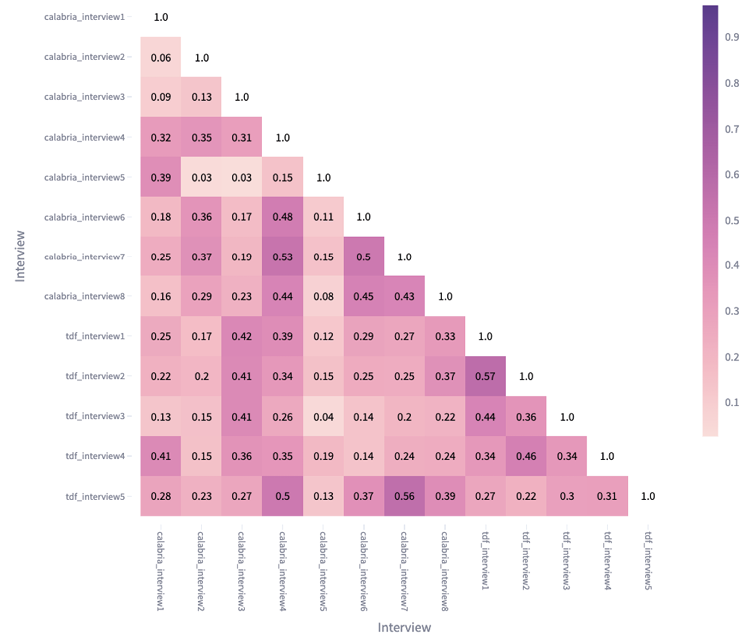
Figure 7 below displays the correlations among various interviews conducted in Calabria and Tierra del Fuego. As a type of graph that uses colour to represent data values, the heatmap effectively visualises the degree of similarity between different interviews according to their overall correlation. Accordingly, each cell represents the correlation coefficient between the content of two interviews, with darker shades indicating higher correlations, providing insights into how closely related the discussions are across different interviews. The general overview of the heatmap shows that the correlations among the interviews vary significantly, indicating that not all interviews share the same themes and emphases. Certain pairs of interviews exhibit high correlations, suggesting that they cover similar topics or perspectives. Conversely, lower correlations indicate that the interviews diverge in their focus or content.
Source: own work based on the interviews’ texts.
In the Calabria interviews, we observe that some interviews have stronger correlations with each other. For example, Calabria Interview 4 and Calabria Interview 7 show a relatively high correlation of 0.53, suggesting a significant overlap in the themes discussed. These high correlations suggest that certain interviews within Calabria share common narratives or focus areas, possibly reflecting regional priorities or shared concerns. For the Tierra del Fuego interviews, we also observe varying degrees of correlation. Tierra del Fuego Interview 2 and Tierra del Fuego Interview 5 exhibit a relatively high correlation of 0.56, as well as Interview 4 and 5 (corr.: 0,46), indicating strong thematic similarities between these interviews. However, not all Tierra del Fuego interviews are closely related. For example, Interview 3 and Interview 4, and 1 and 3, have a low correlation indicating divergent themes or perspectives in the narratives.
When comparing the two regions, some cross-regional correlations were also noticed. For instance, Calabria Interview 8 and Tierra del Fuego Interview 5 exhibit a strong correlation of 0.56. This suggests that certain discussions transcend regional boundaries and highlight common issues or perspectives.
Source: own work based on the interviews’ texts.
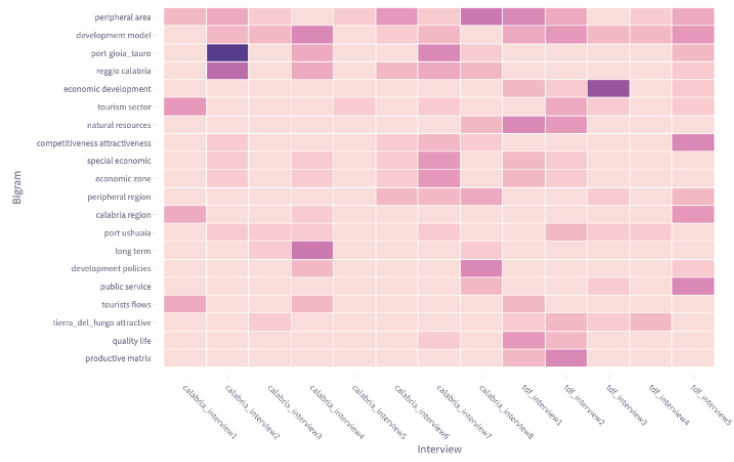
The last figure 8 displays the correlations among the content of the interviews in relation to each interviewee. This initial analysis elaborates the assessment of thematic overlaps and divergences across the interviews, highlighting the complexity and variety of regional development discourses.
Thus, the initial heatmap sets the stage for the more granular examination of specific bigrams and their distribution across the interviews.
Notably, the high correlation between Calabria Interview 4 and Calabria Interview 7 can be further understood by looking at the specific bigrams they emphasise, such as ‘Development Model’ and ‘Development Policies.’ Similarly, the correlation between Tierra del Fuego Interview 2 and Tierra del Fuego Interview 5 can be explored through their shared focus on bigrams like ‘Natural Resources’ and ‘Sustainable Development.’ This detailed visualisation reveals the dispersion of topics and the thematic focus of each interview, confirming earlier findings that ‘Peripheral Area’ and ‘Development Model’ are central themes in the overall discussion.
In Tierra del Fuego, the interviews reveal a strong emphasis on tourism and the attractiveness of the destination as primary drivers for economic development. This focus is evident in the frequent mention of terms like ‘Tourism Sector,’ ‘Tourists Flows,’ and ‘Tierra_del_Fuego Attractive.’ However, this tourism-centric approach coexists with discussions about industrial specialisation, particularly in sectors like natural resources. The key challenge identified is balancing diversification and specialisation to create sustainable development opportunities. This dual focus underscores the region’s efforts to leverage its tourism potential while also strengthening its industrial base to ensure long-term economic resilience.
In contrast, Calabria‘s interviews centre around strategic economic hubs and the implementation of development policies. Terms like ‘Port Gioia Tauro’ and ‘Reggio Calabria’ are frequently mentioned, highlighting the importance of these locations in the regional economy. The interviews reflect a keen interest in leveraging these hubs for broader economic growth. Additionally, ‘Development Policies’ and ‘Productive Matrix’ are significant themes, indicating a focus on policymaking and the structural organisation of productive sectors. The discussions in Calabria point to a concerted effort to use policy and strategic locations to drive development, emphasising the need for effective frameworks and economic zones to foster growth and innovation.
4.2. Views of the key informants: Evidence from the thematic analysis
Thematic analysis is a fundamental technique in applied research for processing qualitative data (Braun and Clarke, 2006; Nowell et al., 2017), particularly verbal expressions derived from open interviews, focusing on recognising, examining, and interpreting recurring themes and sub-themes within the data (Braun and Clarke, 2006). The identification of the relevant key themes depends on the judgement of the researcher, “in terms of whether it captures something important in relation to the overall research question,” (Braun and Clarke, 2006, p. 10). Therefore, it is not associated with any quantifiable measures. In our analysis, we identified recurrent themes and sub-themes (not necessarily linked to the outline of the interviews). We frequently used direct quotations in the text to provide clear evidence about the relevance of a theme.
4.2.1. Tierra del Fuego: Government intervention, economic uncertainty, potentials, and constraints
Tierra del Fuego’s economic trajectory has been fundamentally shaped by the Argentine central government, with state intervention playing a decisive role in structuring its industrial system and demographic trends. The industrial promotion regime (Law 19.640), established in the 1970s, created a Special Economic Zone (SEZ) that provided tax incentives and import benefits to attract investment. This model transformed Tierra del Fuego from a sparsely populated province into an industrial hub, where large-scale manufacturing became the backbone of employment and economic activity.
Informants widely acknowledged that without these incentives, private investment would have been minimal, given the island’s peripheral location and high logistics costs. As testimonies state:
In the 1970s, Tierra del Fuego began hosting factories and industries through the industrial promotion regime, attracting hi-tech industries like TV, washing machine, and later computer and cell phone manufacturing.
The SEZ’s role allowed businesses to receive the necessary benefits to locate on the island, enabling the island’s growth, community growth, population increase, and improved quality of life.
However, despite the economic stability that this model has provided, informants also expressed concerns over the long-term sustainability of such a structure. While industrial activity remains the primary economic engine of the province, it is highly dependent on the continuation of tax exemptions. One interviewee highlighted:
The central government’s role was crucial for shaping the current production and employment landscape in the province… Industry remains the main sector generating employment and will continue to be the main pillar of the province’s productive activity for at least the next ten years.
This informant underlines a key issue regarding the region’s economy, which is not only state-dependent but also structurally limited in terms of diversification. The current industrial model is centred on assembling imported components, rather than fostering local supply chains or encouraging technological innovation. The risk is that any changes to the industrial promotion regime could significantly disrupt employment and economic stability.
Beyond its industrial framework, Tierra del Fuego has leveraged its extreme geographical position to develop a secondary economic driver: tourism. Its branding as the ‘End of the World’ and its proximity to Antarctica have been central to this strategy. This branding has been reinforced through substantial investments in infrastructure. The expansion of the Ushuaia port, the development of an international airport, and the creation of a world-class ski resort have strengthened Tierra del Fuego’s position as a gateway to both Antarctica and adventure tourism. As other interviewees pointed out:
Being the ‘end of the world’ makes many people want to visit the ‘last corner’ of the planet, which we capitalize on by developing a brand associated with nature, a wild reality, and the end of the world.
When the State invested in port capacity expansion, the provincial government invested in an international airport, and the provincial government invested in a world-renowned ski resort.
However, tourism remains a secondary sector, largely constrained by seasonality and limited air connectivity. The core issue at stake is the uncertainty derived from the strong specialisation in the electronics industry, which raises concerns about the region’s capacity for productive diversification. While the industrial promotion regime has sustained economic growth, its long-term implications remain uncertain, as the province’s economic structure is heavily reliant on a single sector.
Furthermore, the co-existence of industrial and tourism-oriented development has not fully resolved some of the island’s most pressing structural constraints. One of the most persistent challenges highlighted by informants is the high cost of logistics, primarily due to the mandatory routing of goods through Buenos Aires. By the will of the Argentine government, all maritime routes – both national and international – must obligatorily stop at the port of Buenos Aires for customs and bureaucratic procedures. This mandatory stop evidently has a negative impact on both the time and cost of maritime freight transport directed to (and coming from) Ushuaia. For example, trans-Pacific routes connecting Asian countries to Tierra del Fuego must necessarily stop in Buenos Aires. This dependency on centralised logistics increases operational expenses and creates significant delays. One interviewee said:
This means that logistics are partly characterized by high costs and significant delays… because it stopped in Buenos Aires and all the bureaucratic issues arrive here. This significantly increases costs.
Beyond logistical constraints, energy infrastructure represents another fundamental challenge. Tierra del Fuego remains disconnected from the national electricity grid, limiting the feasibility of large-scale renewable energy projects despite the region’s significant potential for wind power. One informant highlighted that the lack of interconnection not only restricts local energy development but also increases dependency on costly and less sustainable energy sources:
The potential for wind energy here is vast, but being a peripheral territory, it’s difficult to amortize large investments… The province is not connected to the national grid, making a wind energy system dependent on a much larger market to be economically sustainable.
These structural constraints reinforce a broader paradox: while Tierra del Fuego has successfully developed under a state-driven industrialisation model, its economic trajectory remains highly dependent on external decision-making. Informants recognised the importance of the industrial promotion regime in fostering regional growth but also acknowledged that the province has not developed sufficient endogenous capabilities to sustain itself in the absence of these policies. Despite the fact that the unique competitive advantages, linked to its geographical peculiarity and its natural assets, are not lacking:
Thanks to our peripheral condition, the phytosanitary isolation is a great opportunity... Environmental conditions are an opportunity... The characteristics of the water and natural spaces are special because the level of isolation and remoteness from major consumption centres of the world helps maintain a much more natural and unaltered state.
At the heart of the ongoing debate over the region’s future lies a fundamental tension between competing development models. While long-established industrial interests remain committed to the continuation of the industrial promotion regime, emerging sectors – particularly tourism – are pushing for a reconfiguration of Tierra del Fuego’s economic strategy. The province is at a crossroads, as shifting economic priorities and policy discussions reflect contrasting visions for regional development. Whether the future will be shaped by reforms to industrial incentives, infrastructure modernisation, or a more deliberate push toward diversification remains an open question.
4.2.2. Calabria: Institutional weakness, structural barriers, and some assets
Calabria’s economic development has been shaped by state intervention, but inconsistent policies and governance challenges have resulted in fragmented economic outcomes. Various national and European Union programs have sought to address regional disparities, yet their implementation has often lacked long-term strategic direction. Informants highlighted that while public funds have flowed into the region, they have not translated into sustained industrial growth or economic diversification.
Historically, efforts to stimulate industrialisation included direct subsidies and infrastructure investments, but many of these initiatives have struggled to create a stable path of structural change. Informants indicated that industrial areas have been developed but remain underutilised or abandoned due to inadequate planning and bureaucratic issues, signalling that government policies, rather than fostering industrialisation or regional integration, have often resulted in missed opportunities:
In Calabria, unfortunately, interventions to aid businesses have been not entirely unsuccessful, but a lot of resources have been wasted… There are entire industrial areas, like San Ferdinando near Gioia Tauro, with warehouses that were built but never went into production because they did not have the time to stand alone on the market.
From a national perspective, it remains a marginal region, politically underrepresented, and virtually absent from the Government’s agenda.
Interventions to aid businesses have not been entirely unsuccessful… I believe that out of 10 production facilities, maybe one works.
Weak institutional coordination and inconsistent planning have led to fragmented resource allocation, limiting the long-term impact of industrial incentives. Without a clear and consistent productive strategy, investments have struggled to generate sustained economic activity. Informants pointed to a persistent lack of coherence between development policies and their implementation, leading to inefficient allocation of resources:
There is little coherence between programming instruments and actions taken with cohesion policies. That is, if you don’t have a clear, long-term development model, when financial resources are allocated, there’s a risk that it won’t be used to pursue those long-term guidelines. This would result in wasteful investments such as poorly executed infrastructural projects that remain underutilized and hence represent a waste of resources, a net loss.
The infrastructure deficiencies further hinder economic performance. The lack of adequate transport networks and logistical support has made the region less attractive for private investment, as manufacturing projects often relocate to areas with better connectivity, reinforcing Calabria’s economic challenges. A testimony remarked that:
the location of manufacturing investments is penalized, mainly due to inadequate infrastructure… those who decide whether to locate a production plant in Calabria or in Marche, will most likely choose Marche today.
One of the most persistent critical issues in Calabria is the state of its infrastructure, particularly the transport systems supporting logistics. Road and rail networks remain outdated, limiting mobility and increasing transport costs. These limitations also impact in regional diversification towards tourism activities. Informants emphasised that these deficiencies create bottlenecks that hinder economic expansion and investment:
The roads are old, there is only one highway… train connections are stuck in the 1970s… there is no high-speed line, and sea connections are very few, virtually no maritime connections except with Sicily.
Informants noted that air travel options are limited, and internal transportation networks do not adequately support tourism flows.
Air infrastructure is scarcely available in Calabria, and it wouldn’t take much to enhance it. However, much is needed to strengthen internal transport services: consider that if you arrive at Lamezia Airport, there is no shuttle immediately available to take you to the main hubs of local public transport…
The challenges extend to maritime transports and port logistics, where despite the presence of Gioia Tauro – one of the Mediterranean’s major transshipment hubs – regional industries have struggled to benefit from its operations. Informants indicated that while the port handles international cargo, it remains disconnected from local production networks, reducing its role as a driver of regional development.
Even the logistics sector is penalized, despite having a very important port, Gioia Tauro… it is a port that almost exclusively handles transshipment; large container ships unload and reload onto smaller ships, but only a very small percentage of those goods continue by land.
One interviewee emphasised the lack of intermodal connections and of a railway infrastructure linking the port to the national railway network:
We are very lacking in infrastructure, just think that a container to arrive from China spends less than sending it from Gioia Tauro to Milan, that is, I pay more to do Reggio – Milan than Shanghai – Gioia Tauro.
Another one, operating in the logistics sector, sees the Port of Gioia Tauro as a hidden advantage that could propel the regional economy. They argue that the port enjoys significant locational advantages: it is centrally located in the Mediterranean, which for maritime operators means not only time advantages but also cost savings:
Beyond what everyone may say that Livorno is the centre of the Mediterranean, if we take a geographical map, from the Suez Canal to Gioia Tauro, we can perfectly draw a straight line... Now for a ship that needs to follow a route, what happens? If the line is straight, the consumption is minimal, but a ship that needs to turn a few degrees above, below, implies management costs, fuel costs, economic costs, while Gioia Tauro is practically on the axis, in the heart of Europe.
Additionally, organised crime and corruption have been identified as factors that distort economic incentives and limit the effectiveness of public policies. Informants noted that financial incentives often fail to reach legitimate businesses, instead being captured by groups that prioritise short-term gains over long-term economic sustainability:
The issue of organized crime and corruption also impacts, because often where there are financial incentives, organized crime’s interests are also present… Resources are then concentrated on them rather than on healthier businesses that could stand more strongly in the market.
While industrial development has been insufficient, tourism and cultural heritage still represent key economic assets. Calabria possesses an extensive coastline, national parks, and historical sites, which have the potential to drive economic activity. Informants stressed that the region’s natural and cultural resources are underutilised, as a lack of investment in tourism infrastructure has limited its growth.
The monumental, historical, cultural heritage… kilometres of coastline which allow the development of coastal activities, beach tourism, but also fishing, sports fishing, and mountain tourism… could really be attractors, even internationally, if used and exploited correctly.
Finally, one should consider an ongoing debate about Calabria’s economic future among testimonies, with different actors advocating for a variety of competing strategies. While some emphasise the need for further state support to strengthen industrial and infrastructure development, others argue for a shift toward tourism and cultural industries as the primary drivers of regional growth. However, the challenge remains that neither sector has yet reached a level of maturity that ensures long-term stability. The region continues to face fundamental questions regarding its development trajectory. Whether solutions will come from targeted investments in infrastructure, improvements in governance, or a broader reconfiguration of economic priorities remains uncertain.
4.2.3. Comparative insights: Structural change, intervention, and strategic positioning
The comparative analysis of Tierra del Fuego and Calabria reveals distinct regional trajectories, both profoundly shaped by their peripheral status, yet manifesting in contrasting ways due to differing historical policies, institutional frameworks, and economic structures. Peripherality, in both cases, emerges not as a fixed, immutable condition, but rather as a relational status, constantly negotiated through governance, sectoral specialisation, and the nature of their external dependencies. While both regions grapple with significant structural challenges, the character of those challenges, and the strategies employed to address them, differ markedly.
In Tierra del Fuego, state intervention, specifically the industrial promotion regime, has been the primary driver of economic growth. This has created employment opportunities and fostered a degree of industrial specialisation, particularly in electronics manufacturing. However, this model simultaneously creates a long-term dependency on national policies, which are subject to change and political influence. This dependence introduces an element of economic uncertainty. The need to balance industrial activity with a growing tourism sector, and the reliance on natural resource extraction, further highlight the complex challenges of diversification and sustainable development in a context of limited local control.
The comparison should not be framed as a matter of one region being more or less advantaged than the other. Rather, it highlights how peripherality takes different forms depending on the specific context. Tierra del Fuego’s challenges arise from its reliance on targeted state policies and the need for greater economic diversification, whereas Calabria’s stem from institutional weaknesses and an inability to fully capitalise on its potential advantages. Nonetheless, both regions employ innovative and diverse strategies to address their constraints, underscoring the complex and dynamic nature of peripheral development. This comparison reinforces the need for tailored, context-specific development policies that account for the intricate interplay of internal and external forces shaping each region’s trajectory. Peripherality is not a uniform condition but a spectrum of experiences shaped by distinct histories and power relations.
5. Discussion
The comparative analysis of Tierra del Fuego and Calabria challenges deterministic views of peripherality as an inevitable economic disadvantage, illustrating instead how it manifests in different forms depending on institutional configurations, policy frameworks, and sectoral specialisation (Kühn, 2015; Oppido et al., 2023). While both regions exhibit geographic remoteness at national and continental scales, their development trajectories reveal divergent patterns shaped by state intervention, global economic linkages, and sectoral positioning within the broader economic system (Fitjar and Rodriguez-Pose, 2011; Rodríguez-Pose, 2018). These differences are not simply the result of structural constraints but emerge from historically embedded governance mechanisms and the capacity – or lack thereof – of local institutions to leverage peripherality into development opportunities (Cardoso and Faletto, 1969; Blowers and Leroy, 1994). Understanding these dynamics requires an exploration of the institutional role in shaping economic models, the impact of sectoral specialisation, the extent of international integration, and the broader conceptualization of peripherality as a relational rather than purely geographic condition.
The role of institutions emerges as a central determinant of regional development in both cases, albeit through distinct mechanisms. In Tierra del Fuego, the industrial promotion regime established under Law 19.640 has provided the institutional framework for a sustained manufacturing sector, fostering demographic expansion and economic activity beyond what would be expected given its geographic isolation (Deluca and Kataishi, 2023). However, this model is characterised by significant dependence on periodic state revisions and political negotiations, making its continuity a recurring source of uncertainty (Kataishi and Brixner, 2024; FUNDAR, 2023; Romano, Kataishi, and Durán, 2018). In contrast, Calabria has been the recipient of European Union cohesion funds and national development programs, yet it has struggled to translate these financial resources into a coherent, long-term economic strategy (Musolino and Panuccio, 2022; Ferdinando, Mariarosaria, and Luigi, 2023). The absence of a strong regional industrial base and the fragmentation of governance structures have hindered the region’s ability to capitalise on external interventions, reinforcing a pattern of economic stagnation despite continued public investment (Musolino, 2018). These contrasting institutional arrangements highlight how policy frameworks mediate the capacity of peripheral regions to engage in productive transformation, challenging the notion that peripherality alone dictates development outcomes (Hirschman, 1958; Amin, 1976; Rodríguez-Pose, 2018).
Sectoral specialisation further illustrates the differentiated impact of policy interventions on peripheral development. Tierra del Fuego’s manufacturing sector, based on medium and big size firms, while established through fiscal incentives remains largely exogenous in its technological and productive foundations, with firms operating as assemblers within a highly protected domestic market (Kataishi and Morero, 2020). This dependence on external inputs and policy stability limits endogenous innovation and backward integration into global value chains. Calabria, by contrast, exhibits a more fragmented economic structure, where small-scale entrepreneurship and agriculture remain dominant but fail to generate the necessary scale or specialisation for sustained competitiveness (Musolino et al., 2020). Despite the presence of the Gioia Tauro port, which serves as a major transshipment hub, the lack of regional industrial integration prevents its potential benefits from spilling over into the local economy (Daniele and Marani, 2011; Wilmsmeier and Monios, 2013). The contrasting trajectories of these two cases reinforce the argument that sectoral composition is not merely an outcome of geographic constraints but is actively shaped by policy choices, institutional structures, and historical development patterns (Baumgartner, Puetz and Seidl, 2013; Capello and Cerisola, 2020).
Another key dimension shaping regional trajectories is the extent of international connectivity and participation in global economic circuits. While both Tierra del Fuego and Calabria are peripheral in relation to their national economies, their linkages to external markets differ significantly. Tierra del Fuego’s integration into global trade is primarily tied to its role in the extractive and electronics sectors, although these industries are highly dependent on national policy-driven incentives and foreign technological configurations (Kataishi and Brixner, 2024; Kataishi, 2016). Its export performance, although higher relative to Argentina’s total trade volume, remains concentrated in a few key sectors based on the exploitation of natural resources, reflecting a limited diversification strategy and strong limitations in their production strategy. Calabria, however, exhibits a paradoxical situation: despite its geographic proximity to European markets and its strategic maritime position, it remains largely disconnected from global production networks, with low levels of foreign direct investment and an export sector that plays an insignificant role in its economic structure (Bentivogli et al., 2018; Musolino, 2016). This contrast underscores the idea that physical remoteness does not necessarily determine economic marginalisation; rather, it is the degree of functional integration into global systems that defines a region’s economic position (Gereffi, 1999; Rae, 2017; Rodríguez-Pose, 2018).
Beyond institutional and economic factors, local agency and strategic positioning play a crucial role in shaping how peripherality is experienced and managed (Rivera León and Kataishi, 2010). Tierra del Fuego has leveraged its extreme location as a branding tool, positioning itself as the ‘End of the World’ and a gateway to Antarctica, thereby enhancing its tourism sector (Kataishi et al., 2023; Hall et al., 2013). This strategy has been reinforced by investments in infrastructure and international connectivity, making Ushuaia a key node for Antarctic expeditions and eco-tourism (Gobierno de Tierra del Fuego, 2018). Calabria, despite its rich cultural and natural assets, has struggled to establish a similarly effective tourism model, with its industry remaining seasonal and lacking cohesive branding strategies (Istat, 2019; Censis, 2023). This discrepancy highlights the role of narrative construction and place-based strategies in transforming peripheral conditions into competitive advantages (Blomgren and Sørensen, 1998; McDonald et al., 2018). However, it also points to the tensions inherent in regional economic planning: in Tierra del Fuego, tourism and industrial policies often compete for prioritisation, revealing an unresolved debate about the region’s long-term development path (Kataishi and Ortiz, 2024).
Ultimately, these findings suggest that peripherality should be understood as a relational rather than a static condition, shaped by historical trajectories, institutional frameworks, and strategic economic positioning (Blowers and Leroy, 1994; Eder, 2019). While both Tierra del Fuego and Calabria share a marginal status, their levels of integration into broader economic and geopolitical networks vary significantly. Calabria, despite being closer to major European economic centres, remains structurally disconnected, while Tierra del Fuego, despite its extreme geographic location, has cultivated economic roles that extend beyond its national borders, particularly in tourism and resource extraction (Kühn, 2015; Rodríguez-Pose, 2018). Moreover, the geopolitical significance of Tierra del Fuego – situated between Argentina and Antarctica – contrasts with Calabria’s relatively marginal role in the Mediterranean economy, further reinforcing the argument that peripherality is not merely a function of distance but of strategic positioning within global economic hierarchies (Di Liddo and Manenti, 2017; Fornes and Mendez, 2018).
These insights call for a re-evaluation of traditional frameworks that equate peripherality with economic disadvantage, emphasising instead the dynamic interplay between institutional agency, economic specialisation, and global connectivity. The contrasting cases of Tierra del Fuego and Calabria illustrate how peripheral status is not a uniform condition but manifests in diverse forms depending on the structural and policy contexts in which it is embedded. Understanding these variations provides a more nuanced perspective on regional disparities and offers valuable lessons for development strategies in other highly peripheral areas across different national and continental settings.
6. Conclusions
This work contributes to the ongoing debate on peripherality by reconsidering its nature beyond geographic determinism. Rather than treating peripherality as an inherent disadvantage, the comparative analysis of Tierra del Fuego and Calabria underscores how regional trajectories are shaped by complex and multi-level configurations, economic structures, and historical contingencies. These cases illustrate that peripheral regions do not follow a uniform path; instead, they embody distinct forms of integration into national and international circuits, mediated by governance frameworks, sectoral specialisation, and, particularly, a variety of external dependencies. The evidence suggests that peripherality is not a static condition but a relational status, determined by the degree of agency local actors can exert over political, institutional, and economic processes.
A key insight emerging from this study concerns the role of institutions in structuring economic outcomes. In Tierra del Fuego, the industrial promotion regime has fostered a manufacturing base that has driven population growth and relative economic expansion. However, this model remains heavily dependent on fiscal incentives and exhibits a weak and marginal integration into global value chains, making its long-term sustainability uncertain. In Calabria, institutional fragmentation and the absence of a consolidated industrial policy have hindered the effectiveness of development strategies, despite continuous external financial support. Both cases illustrate how institutions mediate and configure the impact of peripherality, shaping patterns of subordination or reinforcing the role of external actors in determining local and regional structural changes. The evidence indicates that neither case represents a success story or a failure per se but rather different manifestations of peripheral insertion, each with its own advantages, vulnerabilities, and limitations.
Sectoral specialisation emerges as a crucial factor in shaping how these economies integrate into national and international circuits. Tierra del Fuego’s economic structure is characterised by a high degree of concentration, with an industrial base dominated by electronics manufacturing under a state-led framework, alongside a significant reliance on natural resource exploitation, while tourism has developed and grown as a complementary and consolidated strategy. Calabria presents a more fragmented economic landscape, with small-scale entrepreneurship, low-productivity agriculture, and a tourism sector that remains underdeveloped. Both regions exhibit forms of dependence: in Tierra del Fuego, electronics production and natural resources exploitation are largely configured by national decisions, while in Calabria economic stagnation reflects a persistent lack of strategic coordination among local, regional, and national actors. What unites these cases is the low capacity of local stakeholders to influence structural economic changes on their territory, as major decisions on investment, industrial policy, and sectoral diversification are primarily led by external actors.
The relationship between peripherality and global economic integration is equally complex. Our analysis indicates that neither Tierra del Fuego nor Calabria operate as autonomous regional economies; instead, both are inserted into broader frameworks through mechanisms that reinforce asymmetric dependencies. Tierra del Fuego’s integration is structured around its electronic manufacturing sector, where multinational corporations operate under a regulatory framework that limits the region’s role within global value chains. Additionally, its extractive industries, while generating economic activity, are embedded in dynamics that prioritise external interests. Tourism stands as an exception, where the local sector has been able to consolidate sustained growth with meaningful local linkages. Calabria, despite its geographic proximity to European markets and its strategic position in the Mediterranean, remains marginal within global production circuits. The Gioia Tauro port, one of the largest transshipment hubs in the region, operates as an enclave, facilitating trade without generating significant local spillovers. These cases highlight that integration into global markets does not necessarily translate into economic autonomy or sustained development; rather, it can reinforce conditions of subordination, limiting the capacity of local actors to shape economic trajectories.
Our findings also emphasise the relational nature of peripherality, shaped by power asymmetries in the decision-making processes within peripheral regions. In both cases, socio-economic transformations have occurred with local institutions playing a complementary role rather than a leading one. This highlights a structural challenge common to many remote regions: the difficulty of establishing endogenous development strategies that are not contingent on political, financial, or economic decisions made at higher levels of governance. The nature of these relations varies – whether through reliance on fiscal policies, as in Tierra del Fuego, or on European cohesion funds, as in Calabria – but the underlying issue remains the same: the limited or diluted agency of actors in defining their own development trajectories.
In Tierra del Fuego, stakeholders recognise the significance of the promotion regime in initiating and sustaining economic growth and stress the role of institutions in shaping the development model of the province. The current debate extends beyond the continuation of this policy to exploring additional strategies that could enhance long-term autonomy. As the analysis revealed, the Fuegian model faces three critical challenges that could compromise its viability: the insufficient integration of the local community in manufacturing activities, the overexploitation of natural resources without a sustainable framework, and the lack of a coordinated strategy to balance industrial development and tourism at both practical and strategic levels. Furthermore, the future of this development model faces additional challenges due to Argentina’s volatile political landscape. Frequent government shifts create a high degree of uncertainty, posing particular risks for Tierra del Fuego given its distinctive role within the national economy. As a result, any major policy changes could profoundly impact the province’s economic trajectory, potentially undermining the foundations of its current strategic model. This situation underscores a key vulnerability associated with peripherality: the dependency on centralised decision-making and the limited capacity of local actors to influence structural changes. Addressing these challenges requires the development of robust, locally driven strategies capable of mitigating the effects of national political fluctuations.
In Calabria, our analysis highlighted that stakeholders prioritise policies aimed at fostering economic growth, particularly through infrastructure development, and the positioning of novel business models. The focus on initiatives such as the Special Economic Zone (SEZ) and the strategic positioning of the Port of Gioia Tauro highlights a concerted effort to integrate the region more effectively into national and international economic circuits. However, despite these interventions, Calabria faces persistent structural challenges that may hinder the effectiveness of such strategies. The analysis identified three critical factors that constrain its development trajectory: the fragmented coordination between actors, the underutilisation of key infrastructure in fostering local economic spillovers, and the absence of a cohesive approach to leveraging tourism as a driver of growth.
Tourism, in particular, represents a sector with considerable potential, yet institutional inefficiencies have limited its ability to generate sustained benefits for the region. The lack of coordinated governance among public and private stakeholders has resulted in a disjointed tourism strategy, preventing Calabria from capitalising on its cultural and natural assets in a competitive manner. Unlike Tierra del Fuego, which has successfully constructed a strong tourism identity through the ‘End of the World’ brand, Calabria struggles to establish a unified narrative that enhances its appeal to international markets.
Beyond sectoral considerations, Calabria’s long-term development also faces uncertainties stemming from governance fragmentation and the broader political and economic context within Italy and the European Union. While access to EU structural funds represents a crucial opportunity, the effective deployment of these resources remains a challenge due to bureaucratic inefficiencies and inconsistent policy execution. Furthermore, external decision-making processes often shape the region’s economic prospects, reinforcing its dependency on centralised governance structures. As in the case of Tierra del Fuego, this reliance on external actors limits the ability of local stakeholders to define and implement long-term strategies tailored to regional needs.
Future research on these topics could take different directions. Further efforts might focus on surveys of businesses in the two regions to examine their operational models in greater detail. Additionally, studies on the development policies implemented by various territorial levels of government, their historical evolution, and their long-term impacts would provide valuable insights. Another avenue for future research could involve conducting case studies of highly peripheral regions in other parts of the world – such as Asia, Oceania, or North America – applying the same methodological approach. This would expand the empirical evidence on development models in geographically remote regions and deepen our understanding of the structural conditions shaping their economic trajectories.
Autorzy
REFERENCES
AHLGREN, P., JARNEVING, B. and ROUSSEAU, R. (2003), ‘Requirements for a cocitation similarity measure, with special reference to Pearson’s correlation coefficient’, Journal of the American Society for Information Science and Technology, 54 (6), pp. 550−560. https://doi.org/10.1002/asi.10242
AMEEL, L., FINCH, J. and SALMELA, M. (2015), ‘Introduction: Peripherality and literary urban studies’, [in:] AMEEL, L., FINCH, J. and SALMELA, M. (eds), Literature and the peripheral city, London: Palgrave Macmillan UK, pp. 1−17. https://doi.org/10.1057/9781137492883_1
AMIN, S. (1976), Unequal development: An essay on the social formations of peripheral capitalism, New York: Monthly Review Press.
ARRIGHI, G. (1994), The long twentieth century: Money, power, and the origins of our times, London: Verso.
BAER, W. (1962), ‘The economics of Prebisch and ECLA’, Economic Development and Cultural Change, 10 (2, Part 1), pp. 169−182.
BARLÖSIUS, E. (2023), ‘Talking About Social Inequality: Three Concepts of Difference’, sozialpolitik.ch, (1/2023), pp. 1−2.
BAUMGARTNER, D., PÜTZ, M. and SEIDL, I. (2013), ‘What kind of entrepreneurship drives regional development in European non-core regions? A literature review on empirical entrepreneurship research’, European Planning Studies, 21 (8), pp. 1095−1127. https://doi.org/10.1080/09654313.2012.722939
BENTIVOGLI, C., FERRARESI, T., MONTI, P., PANICCIÀ, R. and ROSIGNOLI, S. (2018), ‘Italian regions in global value chains: an input-output approach’, Questioni di Economia e Finanza (Occasional Papers), No. 462, October, Banca d’Italia – Eurosistema.
BIBER, D., CONRAD, S. and REPPEN, R. (1998), Corpus linguistics: Investigating language structure and use, Cambridge: Cambridge University Press.
BLEI, D. M. and LAFFERTY, J. D. (2009), ‘Topic models’, [in:] SRIVASTAVA, A. N. and SAHAMI, M. (eds), Text mining: Classification, clustering, and applications, Boca Raton, FL: CRC Press, pp. 71−94.
BLOMGREN, K. B. and SØRENSEN, A. (1998), ‘Peripherality – factor or feature? Reflections on peripherality in tourism research’, Progress in Tourism and Hospitality Research, 4 (4), pp. 319−336.
BLOWERS, A. and LEROY, P. (1994), ‘Power, politics and environmental inequality: A theoretical and empirical analysis of the process of «peripheralisation»’, Environmental Politics, 3 (2), pp. 197−228.
BRAUN, V. and CLARKE, V. (2006), ‘Using thematic analysis in psychology’, Qualitative Research in Psychology, 3 (2), pp. 77−101.
BRESSER-PEREIRA, L. C. (2009), Developing Brazil: Overcoming the failure of the Washington Consensus, London: Anthem Press.
BUHEJI, M. (2020), ‘Geographic Influence on Innovation and Entrepreneurship Spillovers’, Review of Business and Management, 7 (2), pp. 1−5. https://doi.org/10.5296/rbm.v7i2.16677
CAPELLO, R. and CERISOLA, S. (2020), ‘Concentrated versus Diffused Growth Assets: Agglomeration Economies and Regional Cohesion’, Growth and Change, 51 (4), pp. 1440–1453. https://doi.org/10.1111/grow.12419
CARDOSO, F. H. and FALETTO, E. (1969), Dependencia y desarrollo en América Latina, Santiago: Universidad de Chile.
CENSIS (2023), La classifica Censis delle Università Italiane, Edizione 2023/2024, Rome: Censis.
COPUS, A. (2009), ‘A review of the concept of peripherality and its application to the UK and Scotland’, Scottish Geographical Journal, 125 (1), pp. 3−22. https://doi.org/10.1080/14702540902836922
COPUS, A. (2024), ‘Concepts of spatial and aspatial peripherality’, Journal of Regional Studies, 45 (2), pp. 34−50.
CORBETTA, P. (2015), La ricerca sociale: metodologia e tecniche, III. Le tecniche qualitative (2nd ed.), Bologna: Il Mulino.
CRONE, M. (2012), ‘Re-thinking ‘peripherality’ in the context of a knowledge-intensive, service-dominated economy’, [in:] Regional Development in Northern Europe, London: Routledge, pp. 49−64.
DANIELE, V. and MARANI, U. (2011), ‘Organised crime, the quality of local institutions and FDI in Italy: A panel data analysis’, European Journal of Political Economy, 27 (1), pp. 132–142.
DELUCA, J. P. and KATAISHI, R. E. (2023), La promoción industrial como instrumento central de la economía política y del ejercicio de soberanía en la provincia de Tierra del Fuego, Antártida e Islas del Atlántico Sur, Buenos Aires: Universidad de la Defensa.
DI LIDDO, M. and MANENTI, F. (2017), Competizione tra Stati e Corsa alle Risorse: La Geopolitica dell’Artico, Centro Studi Internazionali, 124, Gennaio.
DOCQUIER, F. and RAPOPORT, H. (2012), ‘Globalization, brain drain, and development’, Journal of Economic Literature, 50 (3), pp. 681−730.
DOS SANTOS, T. (1970), ‘The structure of dependence’, American Economic Review, 60 (2), pp. 231−236.
ECLAC (Economic Commission for Latin America and the Caribbean) (2024), ‘Foreign Direct Investment in Latin America and the Caribbean’, 2024 (LC/PUB.2024/8-P), Santiago.
EDER, J. (2019), ‘Innovation in the Periphery: A Critical Survey and Research Agenda’, International Regional Science Review, 42 (2), pp. 119−146.
EDER, J. and TRIPPL, M. (2019), ‘Innovation in the Periphery: Compensation and Exploitation Strategies’, Growth and Change, 50 (4), pp. 1511−1531. https://doi.org/10.1111/grow.12328
EUROSTAT (2025), Living conditions statistics at regional level, https://ec.europa.eu/eurostat/statistics-explained/index.php?oldid=488652#Highlights [accessed on: 01.09.2025].
EVERT, S. (2005), The statistics of word cooccurrences: Word pairs and collocations, Ph.D. thesis, University of Stuttgart, Stuttgart.
FERDINANDO, V., MARIAROSARIA, A. and LUIGI, F. G. (2023), ‘New development policies for the internal areas of Southern Italy. General principles for the valorization of rural areas in Calabria Region’, Valori e Valutazioni, 33.
FISCHER-TAHIR, A. and NAUMANN, M. (eds) (2013), Peripheralization: The making of spatial dependencies, Bielefeld: Transcript Verlag.
FITJAR, R. D. and RODRÍGUEZ-POSE, A. (2011), ‘Innovating in the periphery: Firms, values and innovation in Southwest Norway’, European Planning Studies, 19 (4), pp. 555−574. https://doi.org/10.1080/09654313.2011.548457
FORNES, G. and MENDEZ, A. (2018), The China-Latin America axis: Emerging markets and their role in an increasingly globalised world, Cham: Springer.
FRANK, A. G. (1966), ‘The Development of Underdevelopment’, Monthly Review, 18 (4), pp. 17−31.
FRANK, A. G. (1967), Capitalism and underdevelopment in Latin America, New York: NYU Press.
FRANK, A. G. (1979), ‘Unequal accumulation: Intermediate, semi-peripheral, and sub-imperialist economies’, Review (Fernand Braudel Center), 2 (3), pp. 281−350.
FRIENDLY, M. (2002), ‘Corrgrams: Exploratory displays for correlation matrices’, The American Statistician, 56 (4), pp. 316−324.
FUNDAR (2023), ‘Diagnóstico del Régimen de Tierra del Fuego’, [in:] HALLAK, J. C., MASCARENHAS, T. B., PEZZARINI, L., BENTIVEGNA, B. and PARK, L. (eds), Diagnóstico del Régimen de Tierra del Fuego, Buenos Aires: FUNDAR.
FURTADO, C. (1964), Development and Underdevelopment, Berkeley, CA: University of California Press.
GANESAN, S., MALTER, A. J. and RINDFLEISCH, A. (2005), ‘Does Distance Still Matter? Geographic Proximity and New Product Development’, Journal of Marketing, 69 (4), pp. 44−60. https://doi.org/10.1509/jmkg.2005.69.4.44
GEREFFI, G. (1999), ‘A commodity chains framework for analyzing global industries’, IDS Bulletin, 30 (2), pp. 1−9.
GOBIERNO DE TIERRA DEL FUEGO, ANTÁRTIDA E ISLAS DEL ATLÁNTICO SUR (2018), Gestión 2016–2020 del Ordenamiento al Desarrollo. Apertura de Sesiones Legislativas Provincia de Tierra del Fuego, Ushuaia: Gobierno de Tierra del Fuego.
GRABHER, G. (2018), ‘Marginality as strategy: Leveraging peripherality for creativity’, Environment and Planning A: Economy and Space, 50 (8), pp. 1785−1794.
HALL, C. M., HARRISON, D., WEAVER, D. and WALL, G. (2013), ‘Vanishing peripheries: Does tourism consume places?’, Tourism Recreation Research, 38 (1), pp. 97−109.
HIRSCHMAN, A. O. (1958), The strategy of economic development, New Haven, CT: Yale University Press.
HOJMAN, D. A. and SZEIDL, A. (2008), ‘Core and periphery in networks’, Journal of Economic Theory, 139 (1), pp. 295−309.
INDEC (2024), Estadísticas Provinciales, https://www.indec.gob.ar/ [accessed on: 07.2024].
INFOLEG (1972), Ley 19.640: Régimen Especial Fiscal y Aduanero para la Provincia de Tierra del Fuego, Antártida e Islas del Atlántico Sur, https://servicios.infoleg.gob.ar/infolegInternet/anexos/25000-29999/28185/norma.htm [accessed on: 07.2024].
IPIEC (2024), Estadísticas Económicas de la Provincia de Tierra del Fuego eIAS, https://ipiec.tierradelfuego.gob.ar/estadisticas-economicas-2/ [accessed on: 07.2024].
ISTAT (2019), Movimento turistico in Italia. Anno 2018. Statistiche report, Rome: Istat.
ISTAT (2024), Istat Regions, https://www.istat.it/en/tag/regions/ [accessed on: 07.2024].
JESSOP, B. (2016), The state: Past, present, future, Cambridge: Polity Press.
KATAISHI, R. E. (2016), ‘La industria electrónica de Tierra del Fuego y el dilema de la competitividad: esfuerzos tecnológicos y competencias desde un estudio de caso’, [in:] Lecturas seleccionadas de la XXI Reunión Anual Red Pymes Mercosur, Córdoba, Argentina: Red PyMEs Eds, pp. 20−44.
KATAISHI, R. and BRIXNER, C. (2024), ‘Importaciones y trayectorias de especialización productiva: un análisis del posicionamiento de Tierra del Fuego en las Cadenas Globales de Valor’, Cuadernos de Investigación Serie Administración, 6, pp. 116−142.
KATAISHI, R., BRIXNER, C. N., CALÁ, C. D. and NIEMBRO, A. A. (2023), ‘Crisis, resiliencia e innovación en sectores estratégicos: reconfiguraciones en el complejo turístico de Tierra del Fuego’, Revista Tiempo de Gestión, 34 (1), Segundo Semestre, UADER.
KATAISHI, R. and MORERO, H. (2020), ‘Taxonomies, Technological Opportunities, and Global Value Chains in Developing Countries: a Literature Review and a Conceptual Approach Proposal’, Investigación y Desarrollo, 28 (2), pp. 168−220.
KATAISHI, R. and ORTIZ, M. E. (2024), ‘Configuraciones Institucionales y desarrollo CyT en la Patagonia Sur: Un Estudio Comparado entre Santa Cruz y Tierra del Fuego’, Revista Tiempo de Gestión, 1 (36), pp. 209−230.
KIM, M. (2013), ‘Many roads lead to Rome: Implications of geographic scope as a source of isolating mechanisms’, Journal of International Business Studies, 44 (9), pp. 898−921. https://doi.org/10.1057/jibs.2013.39
KRUGMAN, P. (1991), ‘Increasing Returns and Economic Geography’, Journal of Political Economy, 99 (3), pp. 483−499.
KÜHN, M. (2015), ‘Peripheralization: Theoretical Concepts Explaining Socio-Spatial Inequalities’, European Planning Studies, 23 (2), pp. 367−378.
LANG, T. and GÖRMAR, F. (eds) (2019), Regional and Local Development in Times of Polarisation: Re-thinking Spatial Policies in Europe (1st ed.), Cham: Springer.
LETAIFA, S. and RABEAU, Y. (2013), ‘Too close to collaborate? How geographic proximity could impede entrepreneurship and innovation’, Journal of Business Research, 66 (10), pp. 2071−2078. https://doi.org/10.1016/J.JBUSRES.2013.02.033
LUHN, H. P. (1958), ‘The automatic creation of literature abstracts’, IBM Journal of Research and Development, 2 (2), pp. 159−165.
MANNING, C. D. and SCHÜTZE, H. (1999), Foundations of statistical natural language processing, Cambridge, MA: MIT Press.
MCDONALD, C., BUCKLEY, P. J., VOSS, H., CROSS, A. R. and CHEN, L. (2018), ‘Place, space, and foreign direct investment into peripheral cities’, International Business Review, 27 (4), pp. 803−813. https://doi.org/10.1016/j.ibusrev.2018.01.004
MEEKER, B. F. (1984), ‘Networks, Exchange, and Coercion: The Elementary Theory and Its Applications’, [in:] WILLER, D. and ANDERSON, B. (eds), Networks, Exchange, and Coercion: The Elementary Theory and Its Applications, Amsterdam: Elsevier.
MUSOLINO, D. (2016), ‘L’attrattività percepita di regioni e province del Mezzogiorno per gli investimenti produttivi’, Rivista economica del Mezzogiorno, (1), pp. 47−72, Bologna: Il Mulino.
MUSOLINO, D. (2018), ‘The north-south divide in Italy: Reality or perception?’, European Spatial Research and Policy, 25 (1), pp. 29−53.
MUSOLINO, D. A. and PANUCCIO, P. (2022), ‘Special economic zones planning for sustainable ports: the test case of territorial attractiveness and urban planning in Calabria region’, [in:] International Conference on Computational Science and Its Applications, Cham: Springer International Publishing, pp. 72−84.
MUSOLINO, D., MEESTER, W. J. and PELLENBARG, P. H. (2020), ‘The mental maps of Italian, German and Dutch entrepreneurs: a comparative perspective’, The Annals of Regional Science, 64 (3), pp. 595−613.
NAMEY, E., GUEST, G., THAIRU, L. and JOHNSON, L. (2008), ‘Data reduction techniques for large qualitative data sets’, [in:] GUEST, G. and MACQUEEN, K. M. (eds), Handbook for team-based qualitative research, Lanham, MD: Rowman Altamira, pp. 137−161.
NOWELL, L. S., NORRIS, J. M., WHITE, D. E. and MOULES, N. J. (2017), ‘Thematic analysis: Striving to meet the trustworthiness criteria’, International Journal of Qualitative Methods, 16 (1). https://doi.org/10.1177/1609406917733847
OPIE, T. R. (2010), On the Outskirts and Wanting In: How Peripherality Perceptions Shape Individual Engagement in Groups, Ph.D. thesis, New York University, Graduate School of Business Administration, New York.
OPPIDO, S., RAGOZINO, S. and ESPOSITO DE VITA, G. (2023), ‘Peripheral, Marginal, or Non-Core Areas? Setting the Context to Deal with Territorial Inequalities through a Systematic Literature Review’, Sustainability, 15 (13), 10401. https://doi.org/10.3390/su151310401
PAASI, A. (1995), ‘The social construction of peripherality: The case of Finland and the Finnish-Russian border area’, [in:] Competitive European Peripheries, Berlin, Heidelberg: Springer, pp. 235−258.
PERER, A. and SHNEIDERMAN, B. (2008), ‘Integrating statistics and visualization: Case studies of gaining clarity during exploratory data analysis’, [in:] Proceedings of the SIGCHI Conference on Human Factors in Computing Systems, New York: ACM, pp. 265−274. https://doi.org/10.1145/1357054.1357101
PEZZI, M. G. and URSO, G. (2016), ‘Peripheral Areas: Conceptualization and Politics. Introduction and Editorial Note’, Italian Journal of Planning Practice, 6 (1), pp. 1−19.
PREBISCH, R. (1949), El desarrollo económico de la América Latina y algunos de sus principales problemas, Santiago: United Nations Economic Commission for Latin America.
PREBISCH, R. (1952), Theoretical and practical problems of economic growth, Santiago: ECLAC, United Nations.
PREBISCH, R. (1972), International Economics and Development, New York: Academic Press.
RAE, D. (2017), ‘Entrepreneurial learning: Peripherality and connectedness’, International Journal of Entrepreneurial Behavior & Research, 23 (3), pp. 486−503. https://doi.org/10.1108/IJEBR-05-2016-0132
RIVERA LEÓN, L. and KATAISHI, R. (2010), ‘Collaboration networks for innovation and socio-economic development: European and Latin American perspectives on digital ecosystems research, local readiness, deployment strategies and their policy implications’, [in:] Digital Ecosystems: Third International Conference, OPAALS 2010, Aracuju, Sergipe, Brazil, 22−23 March 2010, Revised Selected Papers 3, Berlin, Heidelberg: Springer, pp. 1−19.
ROBERTS, A. (2013), ‘Peripheral accumulation in the world economy: A cross-national analysis of the informal economy’, International Journal of Comparative Sociology, 54 (5−6), pp. 420−444.
RODRÍGUEZ-POSE, A. (2018), ‘The revenge of the places that don’t matter (and what to do about it)’, Cambridge Journal of Regions, Economy and Society, 11 (1), pp. 189−209. https://doi.org/10.1093/cjres/rsx024
ROMANO, S. A., KATAISHI, R. E. and DURÁN, L. (2018), ‘La promoción industrial en Argentina: entramado normativo para el caso de la ley 19.640’, Economía, Sociedad y Territorio, 18 (58), pp. 947−976. https://doi.org/10.22136/est20181214
ROSTOW, W. W. (1985), ‘The world economy since 1945: A stylized historical analysis’, The Economic History Review, 38 (2), pp. 252−275.
SERVILLO, L., RUSSO, A. P., BARBERA, F. and CARROSIO, G. (2016), ‘Inner peripheries: Towards an EU place-based agenda on territorial peripherality’, Italian Journal of Planning Practice, 6 (1), pp. 42−75.
SIBLEY, D. (1986), ‘Persistence or change? Conflicting interpretations of peripheral minorities’, Environment and Planning D: Society and Space, 4 (1), pp. 57−70.
STÖHR, W. (1978), Development From Below: The Bottom-Up and Periphery-Inward Development Paradigm. WU Vienna University of Economics and Business. IIR-Discussion Papers No. 4, Vienna: WU Vienna.
STREET, J. H. (1987), ‘The Institutionalist Theory of Economic Development’, Journal of Economic Issues, 21 (4), pp. 1861−1887.
TOYE, J. F. and TOYE, R. (2003), ‘The origins and interpretation of the Prebisch-Singer thesis’, History of Political Economy, 35 (3), pp. 437−467.
WILMSMEIER, G. and MONIOS, J. (2013), ‘Counterbalancing peripherality and concentration: An analysis of the UK container port system’, Maritime Policy & Management, 40 (2), pp. 116−132.
WORLD BANK (2024), World Bank Group Open Indicators, https://data.worldbank.org/indicator/NY.GDP.MKTP.CD [accessed on: 07.2024].
ZIESEMER, T. H. (1994), Economic Development and Endogenous Terms-of-Trade Determination: Review and Reinterpretation of the Prebisch-Singer Thesis. MPRA Paper, No. 54864, Munich: University Library of Munich.
ZIPF, G. K. (1949), Human Behavior and the Principle of Least Effort, Reading, MA: Addison-Wesley Press.
FOOTNOTES
- 1 Data limitations and classification differences hindered comparisons. Adjustments included temporal alignment, currency conversion, and employment rate recalculation using ISTAT metadata.
- 2 World Bank data was used to compare Italy’s and Argentina’s per capita GDP in PPP with their nominal values (USD) and to estimate regional per capita GDP in PPP.
- 3 https://www.ice.it/it/statistiche/Ide.aspx [accessed on: 31.05.2025].
- 4 The share of value added by sector for Tierra del Fuego is calculated based on 2007 (for Calabria, it is again 2016), due to the lack of more up-to-date data from the Argentine National Institute of Statistics. The comparison, while asynchronous, nevertheless provides, in our opinion, significant and useful information for the analysis.
- 5 The Austral Basin, a key extractive region, produced 9.5% of Argentina’s gas in 2018. Its hydrocarbon reserves, expanding through exploration, cover ~6,100 sq. km.
- 6 Calabrian agriculture is highly fragmented, with 42% of farms under one hectare and a strong specialisation. Three crops dominate 78% of marketable production: olives (24.25%), citrus (23.43%), and horticulture (17.25%). New crops, like peaches in the Sibari plain and kiwis in Gioia Tauro, have been introduced. About a quarter of the agricultural area follows organic practices, mainly for oil production. However, the sector remains low in technological innovation and productivity.
- 7 Law 19.640, enacted in 1972, aimed to strengthen Argentine sovereignty over Tierra del Fuego amid concerns the Chilean majority in the region. It promoted Argentine immigration and economic development through tax exemptions (corporate income tax, VAT) and wage incentives. Despite debates on fiscal costs and industrial concentration, the law has been crucial in expanding the region’s manufacturing and technological base, driving its industrialisation.
- 8 In February 2022, Xiaomi announced a partnership with Etercor-Solnik to produce cell phones in Tierra del Fuego.
- 9 This a non-interventional study, where ethical approval is not required according to the national laws (Italy and Argentina).